
The Ultimate Guide to Commercial Models
Break down the four building blocks of a commercial model: monetisation, revenue mechanics, pricing structure, and billing. With real-world examples.
You've built something valuable—a tool, a platform, or a service people actually want to use. But how do you turn that value into profit?
It's time to build your commercial model.
A commercial model defines how your product makes money, how customers pay, and how that money flows into your business. That might be as simple as a flat monthly fee, or more dynamic, with usage-based pricing, tiered plans, or outcome-based contracts.
Getting this right isn't just about setting a price; your commercial model should evolve as your customer base grows. Aligning the value your product delivers to your customers is often a moving target, and there are a range of different pricing approaches available to maximise profit while maintaining a great customer experience.
In this guide, we'll break down the key components of a commercial model, explain how they fit together, and show how leading products—and flexible platforms like Salable—handle this in the real world.
We've analysed how successful products approach this, and what we're sharing here reflects industry best practices. So, it all starts with the building blocks.
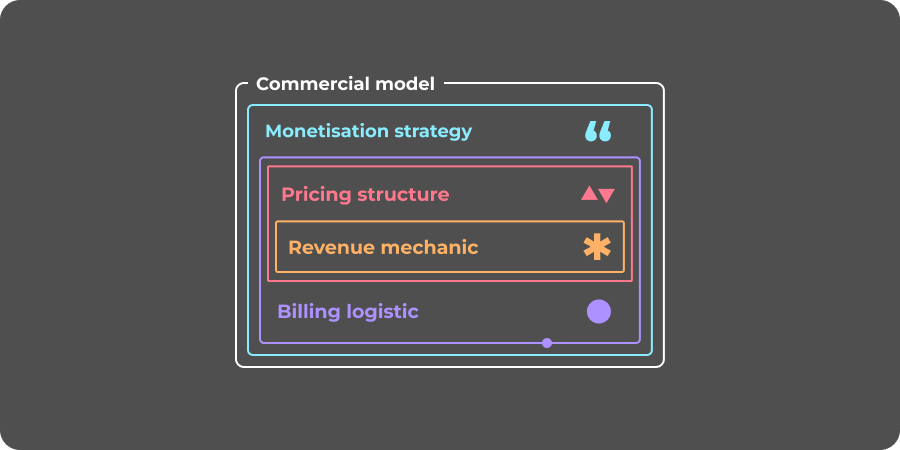
The building blocks of a commercial model
A commercial model is the full go-to-market blueprint, combining a monetisation strategy, pricing structure, revenue mechanics, and billing logistics into one cohesive system. To understand what this looks like in practice, let's break down the commercial model of one of the most talked-about businesses in the world right now: OpenAI.

Monetisation strategy: your plan to make money
To start off with, monetisation defines where revenue will come from. It’s your high-level strategy for turning value into income.
OpenAI’s monetisation strategy for its API is usage-led, it doesn't charge for access or setup. Instead, it earns when customers interact with its products and services. OpenAI monetises on activity, and ties its revenue to the number of tokens consumed–not the number of users for instance.
OpenAI actually monetises two main services:
- ChatGPT: the Chat interface that users can interact with
- OpenAI API: the API that powers ChatGPT, and developers can integrate into their application
Each of these is monetised independently, creating multiple revenue streams, all anchored to real product usage.

Revenue mechanics: how money actually flows
If monetisation is the strategy, the revenue model is the execution. Your revenue model describes the way money is earned—the specific behaviours your customers take that generate income.
The OpenAI API's revenue model, when using the API, is built around per-token fees. Large Language Models (LLMs) break down the ‘cost’ of generating text and images into smaller pieces, or "tokens", which a user pays a fee for each.
While enterprise customers may negotiate pricing and terms, the basic revenue model is the same: customer actions in the product.
Don’t mix them up!
Monetisation is the high-level play—it answers where the money comes from: "We make money when people use our API."
Revenue is the engine underneath—it shows how that money flows in: "They consume tokens, and we bill them monthly."
One spots the opportunity. The other runs the system.

Pricing structure: how the offer is packaged
Pricing is how you package and present your value. It defines how much your customer pays, and for what.
OpenAI’s pricing is:
- Transparent: all rates are publicly listed and easy to understand.
- Usage-based: customers are charged per execution or action.
- Modular: customers only pay for the services they use (e.g. the API, ChatGPT, Codex)
This model works well for developer tools and infrastructure products. It keeps the barrier to entry low and ensures that pricing grows with usage.
At this point, it's good to take a minute to expand on the different revenue models that are available. Salable stands out here, giving businesses full control to design pricing models that match their product, customer base, and growth goals.
- Per-seat pricing for team-based tools
- Flat-rate plans for simplicity
- Usage-based metering for scalability
- Feature-based tiers that lock or unlock functionality
- Modular pricing for product components
Salable is built for composable pricing–so you can mix and match models, test new structures, and adapt as your product and customer base grow.
Whether you want to charge a flat platform fee, add usage overages, gate features by tier, or sell optional modules, Salable lets you combine it all into one flexible plan. No need to choose just one model or rewrite your backend when you need to change.
Plans vs tiers—what's the difference? There’s no universal rule, but here's a helpful way to think about it:
Plan: what the customer sees and selects—e.g. Free, Pro, Enterprise. It defines features, limits, and pricing.
Tier: a level within or across plans—often used internally to manage usage, scale pricing, or unlock support.
Some products use just plans. Others use tiers inside a plan. Make sure your terms are clear and consistent.

Billing: how and when customers are charged
With your monetisation, revenue, and pricing strategy under control, the last step is understanding your approach to billing. Billing defines when your customers pay and how payments are collected—monthly vs annual, prepaid vs postpaid, automated vs invoiced.
OpenAI uses:
- Monthly billing in arrears: customers are invoiced for actual usage at the end of the billing period.
- Automated payments: charges are typically collected via saved payment methods.
- Custom terms: larger customers may receive enterprise contracts with negotiated billing terms or invoicing.
This setup allows OpenAI to align revenue collection with customer activity, keeping cash flow predictable and scaling without friction.
OpenAI’s commercial model works because each component reinforces the others:
- The monetisation strategy is tied to customer activity—OpenAI earns when its users actually use their products.
- The pricing structure is transparent and usage-based—making it easy for developers and founders to adopt
- The billing system is flexible—handling everything from startups to enterprise scale.
Together, these components create a commercial model that's simple to adopt, scales with usage, and aligns value delivery with revenue.
Of course, not every part is optimised for profitability today. OpenAI, like many others, also leans on a loss-leader strategy—offering generous free tiers to grow adoption and build long-term value.
Building your own model
You've seen how others do it—now it's your turn.
Designing a commercial model doesn't start with pricing tables or billing software. It starts with understanding your product, users, and value delivery. Below is a framework to help you think it through—no jargon, no overthinking.
1. Who are your users?
- Are they individuals or teams?
- Are they technical, non-technical, or both?
- Are they price-sensitive, or willing to pay for convenience?
Why it matters: Per-seat pricing works great for teams. Usage-based pricing might be a better fit for solo power users.
2. What value do they get, and how often?
- What's the core job your product helps them do?
- Are they using it daily, weekly, or occasionally?
- Do they rely on a single key feature or use many?
Why it matters: Daily-use tools lend themselves to subscriptions. Spiky usage might call for a pay-as-you-go approach.
3. What do you want to monetise?
- Access (e.g. subscription to core platform)?
- Usage (e.g. API calls, reports, storage)?
- Features (e.g. premium templates, AI tools)?
- Outcomes (e.g. results achieved)?
Why it matters: Salable lets you monetise any of these with different models, so clarity here gives you flexibility later.
4. When should customers pay?
- Do they try before they buy? (→ Free tier or trial)
- Should they commit upfront? (→ Annual plans or credit packs)
- Do they scale slowly or in bursts? (→ Usage-based or hybrid)
Why it matters: Matching your billing rhythm to the customer's buying pattern reduces friction and churn.
5. How much flexibility do you need?
- Do you want to test new plans quickly?
- Will you have multiple customer segments?
- Are you launching into different regions or currencies?
Why it matters: Your first model won't be your last. Salable makes it easy to adapt pricing and plans without engineering effort.
Start simple, then optimise
You don't need the perfect model from day one. Many of the companies we admire started with something simple and evolved over time.
A good starting point:
- One free tier
- One paid tier
- Clear upgrade path
- Transparent billing cycle
With Salable, you can then add usage metering, custom tiers, hybrid models, and billing logic as your business grows.
Trends shaping the future of commercial models
The world of monetisation is shifting fast, and the best commercial models evolve with it. Here are the key trends shaping how modern products charge, bill, and grow revenue.
Usage-based everything
More SaaS companies are shifting from fixed tiers to pay-as-you-go pricing, especially for developer tools, AI APIs, and platforms with variable usage.
Why it works:
- Lowers the barrier to entry
- Aligns price with actual value
- Scales revenue with product adoption
With Salable: Meter anything—API calls, file uploads, active users, and bill based on actual consumption.
Credit and token models
Especially popular in AI, gaming, and design tools, credits offer predictable pricing for unpredictable usage.
Why it works:
- Makes pricing feel simpler
- Encourages top-ups and bundles
- Works well for prepaid usage
With Salable: Let users buy credits upfront, then deduct them automatically as they use features. Want to learn how to get this working? Get in touch!
AI-driven pricing
Some platforms now use machine learning to dynamically set prices based on demand, behaviour, or outcomes.
Why it works:
- Maximises revenue per customer
- Enables personalised offers
- Adjusts in real-time to market signals
With Salable: While Salable doesn't set prices for you, it gives you the building blocks to experiment with custom plans, A/B pricing, and metered logic tied to user behaviour.
Outcome-based pricing
Instead of charging for usage or access, some products charge only when results are delivered—like a % of cost savings or conversions.
Why it works:
- Removes upfront risk for the customer
- Deeply aligns incentives
- Great for enterprise deals
With Salable: you can track value metrics (like conversions or output), then trigger billing only when specific milestones are hit.
Hybrid models are the new default
Most modern pricing strategies now combine elements—e.g. a base subscription + usage overages, or a freemium entry + premium credits.
Why it works:
- Combines predictability with scale
- Captures value from both light and heavy users
- Feels fairer to a broader customer base
With Salable: You can mix and match subscription tiers, usage caps, credit systems, and seat-based logic—all from one platform.
Regional and localised pricing
More products are adjusting pricing to match purchasing power across different countries.
Why it works:
- Increases affordability in emerging markets
- Expands global reach
- Builds customer trust
With Salable: Set different prices or plans by region, apply local taxes (like VAT), and manage currencies–with no code required.
Flexibility is no longer a nice-to-have, it's the foundation of modern commercial strategy. Whether you're experimenting with new revenue streams or adapting to customer feedback, you need a model that can flex as fast as your product evolves.
Salable gives you that flexibility, without needing to rebuild your backend every time your pricing changes.
Not sure where to start? Join our Discord community where you can ask any questions and play around with the AI tool to find out what will work best for you.
Want to Go Deeper?
Join SaaS builders comparing notes on pricing strategy and what actually drives revenue.
Related Posts
Why Letting Customers Pay Less Makes More Money
Flexible SaaS pricing reduces churn. A tailored plan means less revenue than a full upgrade, but far more than a cancellation.
Choose the Wrong Pricing Model, Pay for It Later
Flat-rate, per-seat, or usage-based? Your pricing model should match how customers measure your product's value. Here's how to choose.
One Price. Big Problem.
A single price works at launch but leaves revenue on the table as you grow. Learn when to add pricing tiers and how to get them right.